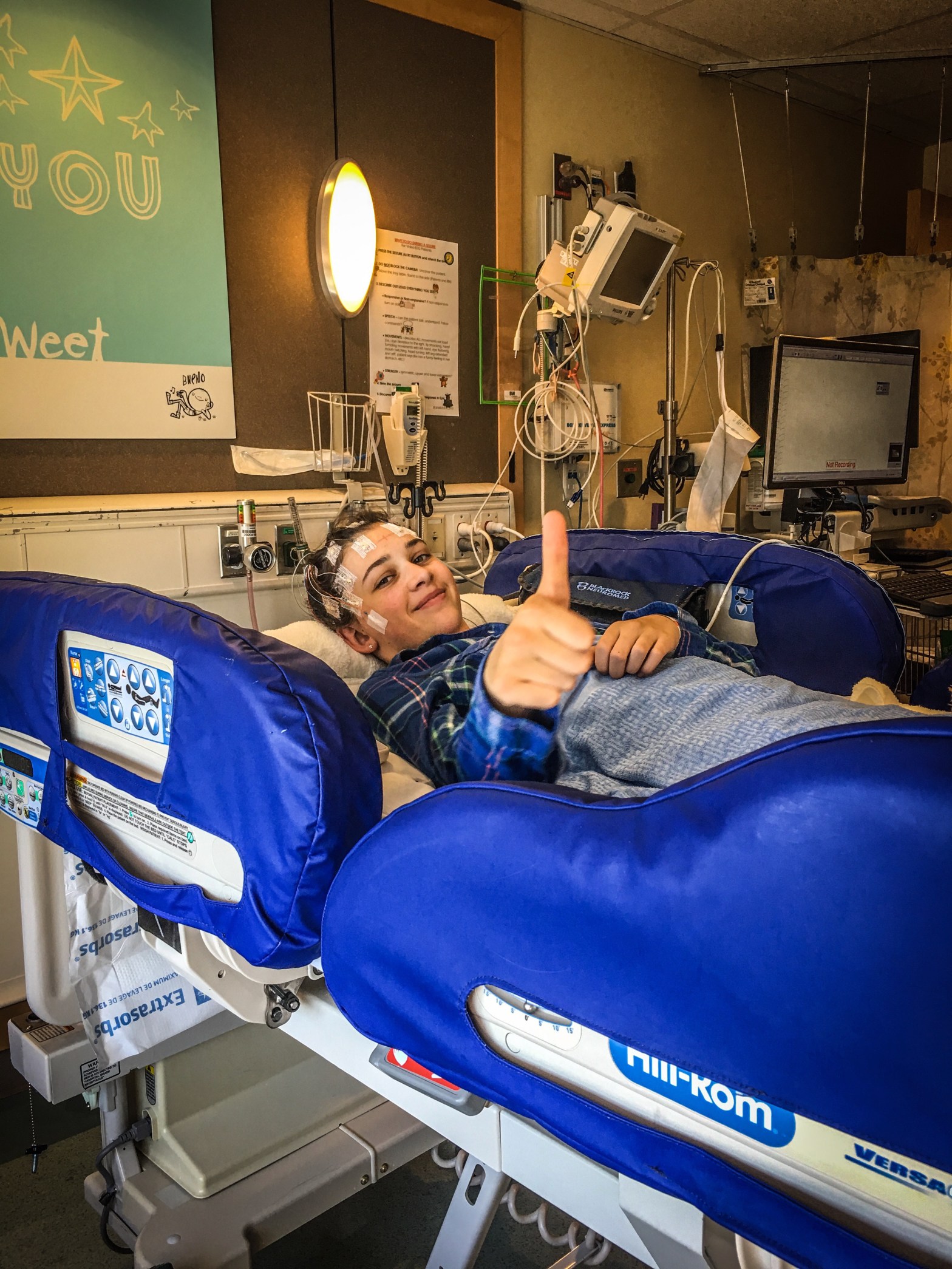
Bright lights flashed dramatically through my closed eyelids. Patterns of green and blue swam in geometric circles. I felt dizzy from squeezing my eyes shut.
“Good job. You may open your eyes now,” the nurse said. I opened my eyes as she pulled the strobe light away and I tried to focus them on the window to my right instead. “I’ll be right back with the doctor. You did great!” The nurse left, closing the door behind her. I had always despised the light and breathing tests. They always performed them on patients to see how their brain waves would react.
My mom sat next to the hospital bed beneath the window. She was reading a book on her phone, or maybe finishing up some emails. I squeezed my hands back and forth and took in a deep breath of the overly sanitized air. I pulled my hands through the tangle of curls and wires reaching up from my head. I kept pulling at the pieces of dried glue holding the electrodes in place. They were everywhere. From my scalp, to behind my ears, to my eyebrows and cheeks. It would take forever to get all the glue out.
The door swung open and a middle-aged Brazilian woman came in. “Hello, Emily. I’m your doctor. Let’s go over the results, shall we?” I tried not to roll my eyes at the awkwardness awaiting me. It was always so awkward when the doctor would talk to my parents as if I wasn’t even in the room.
I looked down at the tray of food still set up next to my hospital bed. I picked up the other half of my peanut butter and jelly sandwich and took a bite. Suddenly, I didn’t feel like eating it anymore. I set it down and picked up my lemon-lime popsicle instead.
The door swung open again and this time another nurse entered and began to set up the area behind my head so that she could start taking the electrodes off.
I sucked on the popsicle, delighted with the mix of sweet and sour blasting in my mouth. The nurse rubbed warm water through my hair and began to rip off the electrodes, leaving remnants of glue.
“So, Emily,” the doctor started. “I just finished reviewing the EEG (electroencephalogram) from the past three nights. You got here Monday?” I nodded. Yep, four days in bed during summer. How fun. “Perfect. Well, I’m just going to say it,” she started, her accent undermined by her words. My heart began pounding. “You have epilepsy. It is what type of seizure you have. I’m going to take your mom outside and then we will come back and I’ll explain what we are going to do moving forward, okay?” The words cut through me. But not like a sword or a knife. It was like air. I couldn’t grasp the words. All I saw was my mom. Her eyes welling up, holding in the cry. She went quickly with the doctor, brushing past me.
“Do you want me to put on a movie? Or maybe I can get you another snack?” The nurse tried to distract me. I set my popsicle down, squinting through the glass pane on the door. My heart was jumping up and down in my chest. What’s epilepsy? I wondered. I began to fear for the worse. Was I going to die? Would I have to live in a hospital for the rest of my life? I couldn’t breathe. I was only 15-years-old. I had an episode of something seizure-like in January and I had come back and forth to and from the hospital ever since. It was now August, and the shiver racing up my spine contradicted the sunny weather just beyond my window.
The doctor came back in and my mom went and sat down under the window, hand on the side of the bed. “Epilepsy is quite common and yours is not extreme. However, you cannot drive until you haven’t had an episode for six months. You need to be put on medication right away. We will send forms to the school to make sure that the teachers are aware. Sports like swimming, which your mom told me you do, need to be supervised in case you have an episode. And don’t go out in open water like the ocean.” The doctors’ words blended in my head, mushed themselves together and fell apart. I clenched my teeth and urged myself not to cry. I wanted to yell at her and tell her how unfair this was. I had just finished driver’s ed! I just found my love for swimming! I had just found myself! Who was I now?
When she left and the electrodes had been cleared from my head, I went into the bathroom and cried. I cried away the girl I knew and faced the new girl in the mirror. The broken girl. The messed-up girl. The pitied girl. I kicked the wall and sobbed even harder. I screamed at my mom and at the doctors who couldn’t hear me. I cried for about an hour until I couldn’t even breathe anymore. I felt so broken inside.
“Emily?” My mom knocked lightly on the bathroom door. I got up from the ground and squeezed out my wet hair with a towel after having taken a shower. I opened the door and walked over and sat on the bed. I didn’t want to talk. “It’s not the end of the world, sweety.”
I decided I would play mute and grabbed my things and stuffed them into my bag. I looked down at my melted popsicle that held both sweet and sour. To this day, I remember looking at the stick that had held a whole popsicle. It had been left out and exposed, melted from the elements. It was like me. Fine one minute, gone the next. I decided I didn’t want to feel this way. Purple (the official color for epilepsy awareness) had always been in my life. I just didn’t know it. I was so full of anger and hate, but I knew I wouldn’t stay that way. I walked out of that room, tears streaking my face, defeated. But I knew the next time I visited, I would enter with my head held high. That was one thing I always knew about myself; I was strong, and I would continue to be strong no matter what.
2019 was one of the hardest years I have ever gone through. All the things I couldn’t do and losing my grandma and great-grandma to old age. I felt I had lost myself. But through that, I realized that the good thing about hitting rock bottom was getting to build my way back up. The vision of the melted popsicle will always be with me, and so will purple. I can’t change who I am and I don’t want to. When my life started falling back in place, that’s when I realized I would be forever purple, but I would be proud of the person it molded me to become.
In the following year, I overcame obstacle after obstacle. I struggled with finding the right epilepsy medication and at one point I could feel nothing. The medicine took away my emotions. On the day after Christmas, I was in the hospital but was given the exciting news that I could drive again. Later, I started back with the swim team and playing soccer. I overcame everything the doctors told me I couldn’t do and more. I got my first job as a journalist working as a copy editor, something I didn’t think could happen until I was older. I got a promotion after working there for only two months and became a staff reporter as well. I became a leader at my church and began stepping out in my community and my faith. I wrote a devotional about how every person is a gift and about my experience on a mission trip to Swaziland. This was published on an app with over half a billion downloads. I got my driver’s license and overcame obstacles related to mental health. I didn’t just build back my life within the following two years, I improved it. I learned to take chances to succeed because you never know where life will take you. I learned that every struggle we go through shapes us into the person we are today and every obstacle we overcome strengthens us and builds grit. I have learned so much at an early age and those lessons have catapulted me into taking every shot I can because I know what the power of resilience can mean for someone’s future. When someone can bounce back from adversity and come back stronger, nothing can stop them.
 EMILY DICKINSON